


If art is supposed to imitate life, what better art to examine than images from the classic 1934 film Imitation of Life? The plot follows the friendship of two adult women, Bea Pullman (Claudette Colbert), a white widow, and Delilah Johnson (Louise Beavers), a Black housekeeper; the two start a business selling pancakes made from Delilah’s special recipe and raise their daughters together. Delilah’s light-skinned daughter Peola (Fredi Washington) decides to separate completely from her mother in order to pass as white, only repenting when Delilah dies of a broken heart as a result. In one scene, Peola attends her mother’s funeral and breaks down at the casket, sobbing for her mother’s forgiveness beyond the grave.
Fredi Washington and Louise Beavers in a scene from Imitation of Life (1934)
Image: Schomburg Center for Research in Black Culture, Photographs and Prints Division, The New York Public Library
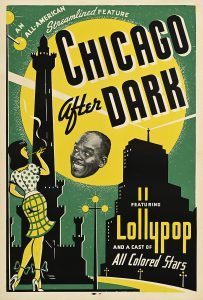
Act Black: Posters from Black American Stage & Screen, on view at Poster House, demonstrates that most of the posters from the 1934 version of the film (it was remade in 1959) feature only the film’s white characters, particularly its star Claudette Colbert, then at the peak of her career. (Imitation of Life was just one of three movies starring Colbert that were nominated for Best Picture at the 7th Academy Awards in 1935.) But other posters, likely made for Black theaters and audiences, spotlight Black actresses Louise Beavers and Fredi Washington. The film’s producers clearly had at least some interest in exploiting Washington’s looks to capture public attention—but they did so strategically.
Imitation of Life (1949), by Designer Unknown
Poster House Permanent Collection
Washington herself also used her beauty to further her stage and film career, and later, her writing and activism. When the film was released, she was deluged with mail from fans complimenting her performance and pleading for signed photographs; she happily obliged, building a solid fan base across the country. Admirers like Albert Robinson from Trenton asked “would you please sent me a picture of your self [sic]. You are my best colored actor. I would like the picture so I can hang it up in my room. I am a colored boy myself” But other fans, eager to see her in more productions, also encouraged her to consider passing as white. “I think you played your part wonderful and I like the part that you played because I am colored,” wrote James Samson of Chicago. “Off [sic] course we understand this is just a picture but I mean if this was in real life if you could pass for white and play the part of Mae West and make Billion [sic] of dollars.”
Fan mail from James Samson, (c. 1935–1948)
Images: Fredi Washington Papers, 1925–1979, Amistad Research Center, Tulane University
So what stopped Washington from passing and making “Billion of dollars?” It was largely due both to where she had come from and where she wanted to take herself. Fredericka “Fredi” Carolyn Washington was born in Savannah, Georgia in 1903. Both her parents were light-skinned African Americans. The family fled with millions of other African Americans from the Jim Crow South to the northern cities of the United States in search of better opportunities. Washington was always aware of her good looks and sought to use them to break into a performing career. When she was first cast as a chorus girl in Shuffle Along in 1921 (alongside a young Josephine Baker, who became a lifelong friend), she was told by the financier Otto Kahn that “You look French. You could easily be French,” and that she should pass as white to increase her chances of success in the entertainment industry. But she wanted no part of that, allegedly retorting that “I want to be what I am. Nothing else.”
Chorus line in the stage production Shuffle Along, including Fredi Washington (4th from right) and Josephine Baker (6th from right) (1921)
Image: Billy Rose Theatre Division, The New York Public Library
“Nothing else” often proved to be a moving target. For instance, Washington had to darken her pale complexion with makeup when she played opposite Paul Robeson in The Emperor Jones in 1933 to avoid the risk that audiences might assume that Robeson’s character was romancing a white woman. As Act Black describes, the Hays Code that reigned in Hollywood during Fredi’s film career banned even the perception of “sex relationships between the white and black races.” If Washington refused to pass for white but was prohibited from starring in films alongside other Black artists without blackface, her film career simply couldn’t advance.
Paul Robeson & Fredi Washington in The Emperor Jones (1933)
Image: Wikimedia
Perhaps it was these concerns about her career and about Hollywood in general that prompted Washington to become a founding member of the Negro Actors Guild in 1936. She was selected to serve as its executive director, writing the fledgling organization’s mission statement in support of Black actors and managing its finances. As she grew in the role, her excitement about activism and a dwindling number of opportunities in the film industry led to the gradual end of her film career. Her increasing indignation at racism in the entertainment field also resulted in her turn toward left-wing politics, and as the anti-Communist paranoia of the Red Scare began ruining artists’ careers, it was clear that the sharp political mind behind the beautiful face was a liability.
Washington therefore chose to embrace her activism and writing. After cofounding the Negro Actors Guild, she began writing a column in the People’s Voice, a progressive newspaper. In 1954, she served as a casting consultant on the film Carmen Jones, resulting in a young Dorothy Dandridge landing the title role. This would catapult Dandridge to stardom and break racial barriers in the film industry; Dandridge’s performance garnered the first-ever nomination in the Best Actress category for a Black woman.
Carmen Jones (1954) by Scott McKowen
Image: Wikimedia
While Washington did not become a big film star after Imitation of Life, her pivot to behind-the-scenes activism created new opportunities for Black actors from younger generations. Her appearance, captured and complicated in film posters, undoubtedly limited her chances as an actress. But her advocacy and example would define her contributions to the film industry for years to come.
Fredi Washington in later life
Image: Connecticut Historical Society
Dominique Jean-Louis, PhD, is the Chief Historian of the Center for Brooklyn History at the Brooklyn Public Library, where she has most recently curated the exhibition The Battle of Brooklyn: Fought and Remembered (2026), and Trace/s: Family History Research and the Legacy of Slavery in Brooklyn (2025). She received her B.A. in Comparative Ethnic Studies from Columbia University, and her Ph.D in US History from New York University, with her doctoral research focusing on race, education, and immigration in post-Civil Rights Era Brooklyn. Dominique regularly writes and lectures on Blackness in America and New York City history.