


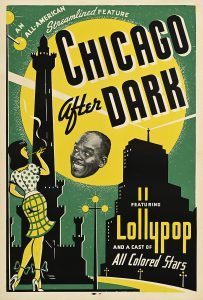

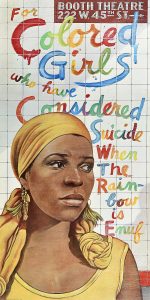
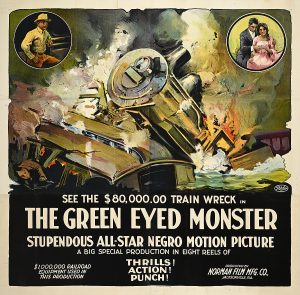
Act Black: Posters from Black American Stage & Screen is a groundbreaking exhibition for Poster House: it features the largest combined display of posters and ephemera in the museum’s history and examines the legacy of all-Black films and the cultural changes that brought an end to the race film category. An early iteration of this exhibition extended the narrative into the 1960s, including posters for plays and films in which directors and producers reworked earlier content for audiences of the day. These posters are held in the museum’s permanent collection, and while they were not included in Act Black in the end, they offer a compelling perspective on the evolving portrayal of race and the relationship between Black and white communities in the United States. Whether they are adaptations of existing materials or new works, these posters reflect both the shifting cultural landscape and some of the social issues affecting the audiences they sought to captivate.
The race film category emerged in the early 20th century and described films with all-Black casts that were intended for Black audiences. Often produced and created outside the Hollywood studio system, these films were made on modest budgets but nonetheless fascinated audiences with their compelling performances, vibrant musical scores, and complex narratives. By the 1950s, race films began to evolve alongside the broader civil rights movement. As legal and social racial barriers were increasingly challenged, Black and white actors advocated for the representation of complicated interracial dynamics and a wider range of Black topics and actors on screen. At the same time, Hollywood studios recognized both the commercial and cultural significance of Black talent. This shift also prompted producers to adapt plays into film and to create fresh stories with an entirely contemporary perspective. While such developments significantly expanded the characterization of Black experiences and perspectives on film, they also mirrored the ongoing racial tensions in America—both on and off the screen.
Anna Lucasta (1956) by Designer Unknown
Poster House Permanent Collection
One Black-cast film that represents these changes is Anna Lucasta, based on the play of the same name by Philip Yorden. It was inspired by Eugene O’Neill’s Pulitzer Prize-winning play Anna Christie, produced in 1921, about a young Polish sex worker. Abram Hill and Harry Wagstaff Gribble, the directors of the American Negro Theatre in Harlem, purchased the rights to Anna Lucasta, updating it as an all-Black production that premiered at the theater in 1944. Then, in 1958, the play was adapted into film for the second time in a version featuring the stage and screen sensation Eartha Kitt and the renowned musician Sammy Davis Jr. While neither the window card nor the poster provide any information about the all-Black cast, there are still prominent differences between the two. Most apparent is the colorized image of the actors on the poster, indicating that Black actors are in principle roles in this film even though it does not explicitly tackle the subject of race. This poster is also focused on a more sexualized image of the main character, and shows Kitt’s body lying on the ground in a revealing dress between the two words of the title and beneath the suggestive and sensational tagline “The Blistering Story That Undresses the Heart of a Tramp!” This method of advertising for Anna Lucasta was clearly designed to titillate and entice viewers. Eartha Kitt would become well known for her political activism, supporting civil rights, the peace movement, and same-sex marriage.
Imitation of Life (1959) by Designer Unknown
Poster House Permanent Collection
Fannie Hurst’s 1933 novel Imitation of Life tells the story of two single mothers (one Black, one white) who raise their daughters together and start a waffle business. The book deals with the topic of racial “passing”—the ability or desire of a person to “pass” as someone of another race, typically white. The story was adapted by Universal Pictures into a movie of the same name in 1934 (it was rereleased in 1949) with Louise Beavers and Fredi Washington playing the Black mother and daughter who must navigate this complicated situation. In 1959, the film was remade and starred Lana Turner and Juanita Moore as the two single mothers. However, in this version, rather than casting a Black actress in the role of the daughter who decides to pass, the producers chose a non-Black actress, Susan Kohner. This decision was entirely typical of Hollywood casting directors who mostly prioritized the comfort and perceptions of white audiences over authenticity or meaningful change, overcorrecting the decision to use the Black actress Fredi Washington in the role almost 25 years earlier. The film’s poster centers the predominantly white cast, a stark contrast to the 1949 advertisement for the rereleased 1934 film; in that composition, designed specifically to appeal to Black audiences, Beavers and Washington are the focus. The inclusion of black-and-white images in this 1959 poster might also have been intended to de-emphasize the race of the actors.
I Passed for White (1960) by Designer Unknown
Poster House Permanent Collection
Based on the 1956 memoir I Passed for White by Reba Lee, the 1960 film adaptation told the story of a biracial woman who marries a wealthy white man; he is unaware of her half-Black identity. The film ultimately presents the trope of the tragic mulatto—a character with a half-Black identity who experiences self-hatred, depression, and literal or metaphorical death. The poster centers the protagonist played by white actress Sonya Wilde, who was not, in fact, biracial. Given the existing taboo around interracial displays of intimacy and the illegality of interracial marriage in many states at this time, a white actress was cast in this role so that white theatergoers were not deterred from viewing the film, especially those in the South where there were strict legal racial barriers. This film is often compared to Imitation of Life but the quote on the poster points to a more direct approach to market a film about biracial plight, one that exploits this harmful trope to attract viewers.
Guess Who’s Coming to Dinner (1967) by Designer Unknown
Poster House Permanent Collection
In June 1967, the Supreme Court issued a landmark ruling: Loving v. Virginia that banned all legal race-based restrictions on marriage, allowing interracial marriages to be both acknowledged and upheld throughout the United States. In December of the same year, the film Guess Who’s Coming to Dinner was released, featuring a relationship between a Black male doctor (played by Sidney Poitier) and a young white woman (played by Katharine Houghton). The film shows the white family ultimately accepting the union, reflecting this new cultural change. Poitier also stands at the center of the narrative and plays an unassailably dignified and respectable figure, one seen by some critics as too perfect and designed to appeal mainly to white audiences. This impeccable level of behavior was clearly not imposed upon the characters portrayed by white actors. This approach is also suggested in the poster which advertises the film as a contemporary love story, highlighting a progressive view of a dynamic that remained heavily politicized and widely condemned. It was, however, also a daring choice to show the couple arm in arm here; only a few years earlier, such gestures would have been prohibited in printed media. Theatergoers in the South as well as those elsewhere were still interested in seeing Guess Who’s Coming to Dinner, marking a significant social change. The film was nominated for many national and international awards, receiving two Academy Awards in 1968 at a ceremony held only six days after the assassination of civil rights leader Martin Luther King Jr.
Films addressing race-related issues changed dramatically during the 20th century. The posters considered here captured more than the content of such films; their designers presented a wide range of topics, often deploying sensational messages and provocative images in an effort to inform a new generation of theatergoers interested in seeing Black actors and a range of race-related stories, even if they sometimes radically understated the realities. At a time when legal and societal barriers were being dismantled, these posters remind us of the ways in which film advertising mirrored both negative and positive perceptions of race as studios began to introduce more complex and challenging race-related content into their standard fare.
Es‑pranza Humphrey is the Assistant Curator of Collections at Poster House, where her research centers on Black performance, fashion, and visual culture. Her scholarship on the graphic language of the Black Panther Party has been featured in The New Yorker, NPR, and ABC’s Here and Now, as well as several international publications. Her current exhibition Act Black: Posters from Black American Stage and Screen explores Black American theater and film posters from the 1870s to the 1940s.