



I have a theory I’ve developed over the years as a gay man who has been a member of the target audience for AIDS posters my whole life, as a curator of an AIDS poster exhibition for the U.S. National Library of Medicine, and as a longtime writer and educator on HIV/AIDS.
AIDS posters are strongest when they communicate hope and possibility. Otherwise, why would someone feel compelled to learn about the virus, get tested, or start and stay on medication? Viewers—whether living with HIV or fearing they may be—need to know about the existence of resources and community.
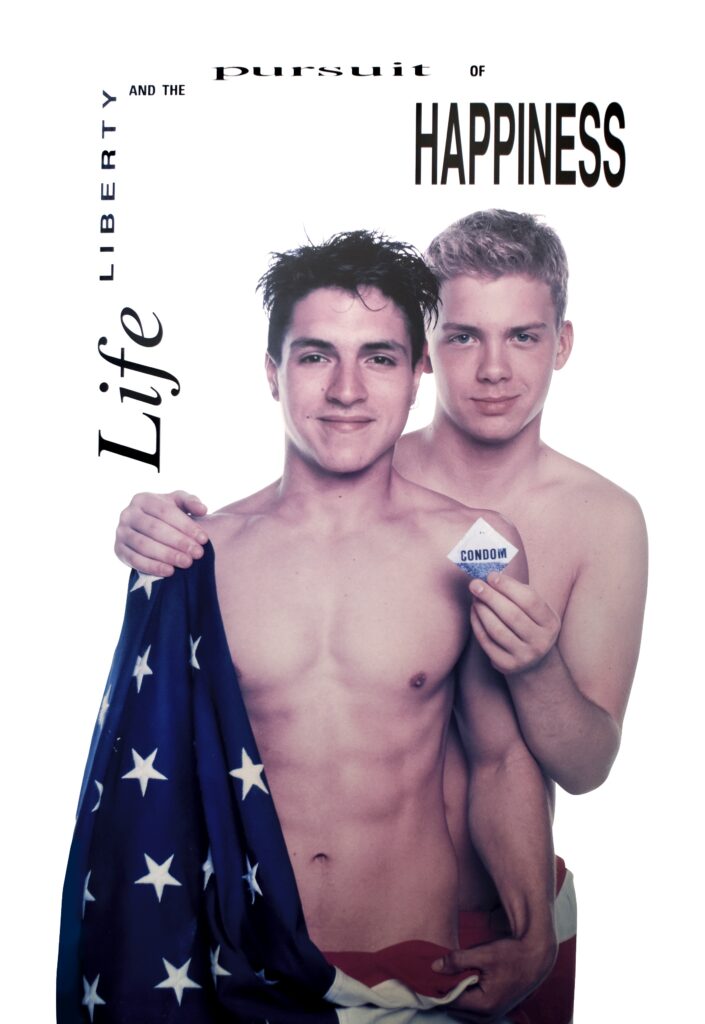
This may sound obvious, but history shows otherwise. Many of the first posters I remember—whether produced by government agencies or pharmaceutical companies—were impersonal at best. Before it became standard for them to feature “real people,” , two modes dominated the field: sex-positive posters for gay men built on narrow Eurocentric beauty ideals, and vague, sanitized posters for the general public aimed at avoiding conservative backlash.
Left: Life, Liberty, and the Pursuit of Happiness (1990), photography by Warwick May, produced by SFAF and Haight-Ashbury Free Clinic, San Francisco AIDS Foundation
Right: Most People… (1993), part of America Responds to AIDS, produced by the Department of Health and Human Services
These were considered improvements only because they followed an earlier era when fear of death was the primary motivator used in AIDS posters and PSAs. It took activist and media pushback to move beyond that approach.
Fortunately, amid many ineffective campaigns, remarkable AIDS posters have emerged—often created by independent or community-informed artists—using lived experience to convey the possibility of a full life with HIV.
Below, I test my theory of what makes an effective AIDS poster by examining three examples, ending with a brief reflection on the kinds of posters that are really needed now.
The First AIDS Poster
Before it became headline news, HIV/AIDS was an unnamed, mysterious illness primarily affecting people who injected drugs, their newborns, gay men—and eventually many others. While little was done to link these communities, individuals like public health nurse and gay rights activist Bobbi Campbell began to use their lived experience to help those around them. Along the way, Campbell created what is now considered the earliest known AIDS poster.
In 1981, Campbell was diagnosed with Kaposi’s sarcoma (KS), a cancer that causes swelling and lesions. This diagnosis was common before HIV was identified and before terms like HIV and AIDS existed.
Shortly after, Campbell began writing for a local San Francisco newspaper, calling himself the “KS Poster Boy.” The moniker wasn’t a joke; he embraced it. He photographed his lesions, developed the images, and mounted them on a sheet labeled “GAY CANCER.” Around the photos he wrote a message urging anyone with similar marks to contact the UCSF center studying the illness. He hung this early public health notice in the window of Star Pharmacy, a well-known shop in the city’s Castro District.
Men reading Bobbi Campbell’s flyer (1982), photography by Rink Foto.
Before the internet, handwritten signs were often posted in local businesses. Anyone who grew up in the 1980s remembers scanning bulletin boards in laundromats, record stores, and cafés. In this culture, Campbell shared his suffering—and what he was doing about it—to educate others. His sign offered language, solidarity, and guidance for people confronting the illness. In a column from that time, he said, “I’m writing because I have a determination to live. You do, too—don’t you?”
A year after his diagnosis, “AIDS” became the official term for the illness. Campbell, always ahead of the curve, began wearing a shirt he had designed reading “AIDS Poster Boy.” It was accurate then, due to his diagnosis—and now, because he created what may have been the first AIDS poster.
The Hand-Drawn Poster
By the mid-1980s, HIV had been identified, tests were available, and although effective treatment was still a decade away, people were learning how to live with the virus. That included navigating dating during an epidemic.
A 1989 hand-drawn poster captures this moment. It shows a woman embraced by a man; his face is unreadable, hers clearly miserable. Above them are the words “BABY, I could just die for you!” and below them “Wait a minute…I could just Die For You. AIDS— THINK FIRST!”
Baby I Could Just Die For You (c. 1988), artist unknown, SCAEN
This striking message is rooted in gender and power imbalances, and highlights how misogyny can limit women’s agency in sexual relationships.
While Campbell’s poster focused on seeking medical care, this one urges viewers to consider the fact that if AIDS is a death sentence, survival requires safety and trust within partnerships. Without stating it directly, the poster encourages conversations about condoms, monogamy, communication, and more.
Left: Mommie What Do I Take To A War On AIDS? (c. 1988), artist unknown, SCAEN
Right: Learn to Live/Learn About AIDS (c. 1988), artist unknown, SCAEN
These posters are from a small series of HIV-related works about dating and the experiences of children growing up with or affected by HIV. The acronym SCAEN—the South Carolina AIDS Education Network—appears in the corner.
SCAEN was founded by hairdresser DiAna DiAna, an early innovator in AIDS education. A 1990 documentary shows women in her South Carolina salon chatting about everything—from kids and neighbors to HIV/AIDS—while getting their hair done. DiAna recognized the special influence a hairdresser can wield. Clients came for a style but left with tools to make healthier choices.
Outside the salon, she hosted AIDS-education parties where, amid playful games reminiscent of bachelorette parties, women shared stories and strategies for navigating sex, pleasure, and relationships in an AIDS-informed world. The posters—by an unknown artist—capture the spirit of DiAna’s work and the power of the community she cultivated.
I Love My Boo
The second decade of the 21st century brought major changes in the AIDS response, including the introduction of PrEP (Pre-exposure prophylaxis, a daily medication that can reduce a person’s chances of contracting AIDS) in 2012 and the 2016 adoption of “U = U,” the message that effective treatment prevents sexual transmission.
Before this shift, after life-saving medication arrived in 1996, AIDS organizations were learning to reframe HIV as a chronic rather than inevitably fatal virus. Meanwhile, despite media narratives declaring that the plague was “over,” the crisis continued—especially for Black gay men and other gay men of color.
I love my boo (2011), photography by Luna Luis Ortiz, The Institute for Gay Men’s Health, GMHC
It was in this context that the “I Love My Boo” campaign was launched in 2008, and was expanded in 2010 and 2014. Created by Gay Men’s Health Crisis (GMHC), the posters first appeared in the bathrooms of gay bars. They featured photographs by Luna Luis Ortiz of young Black and Latino men in tender public embraces. Unlike earlier AIDS posters, they weren’t slick or clinical; they were personal, stylized, and deeply relatable.
In a world saturated with homophobic and racist messaging, these images of queer Black and Latino love were a balm—an opportunity to see oneself reflected or to witness images of love that some people had never seen before.
The posters read “i love my boo,” with many also including the words: “We’re about trust, respect and commitment. We’re PROUD of who we are and how we LOVE.”
This echoed the 1983 safer-sex pamphlet How to Have Sex in an Epidemic, in which Richard Berkowitz and Michael Callen wrote: “If you love the person you are fucking—even for one night—you will not want to make them sick. Maybe affection is our best protection.”
Across time, a shared truth emerges for those marginalized because of their race, sexuality, or erotic life: our ways of loving shape us—and can save us.
Some of the “I Love My Boo” posters made this explicit: “safer sex is one way we show our love.”
Notably absent from these pieces were terms like HIV, AIDS, testing, condoms, or medication. Created by GMHC—the world’s first AIDS service organization—the campaign marked a shift away from didactic prevention and toward affirmation as prevention. It decentered the virus and recentered connection and care.
Years later, I helped design a poster that revealed the power of this shift. My friends Alexander McClelland and Jessica Whitbread launched PosterVirus, a public art project exploring HIV’s social and political impact.
Inflamed (2013) by Chaplain Christopher Jones and Theodore (Ted) Kerr for PosterVirus
When they asked me to contribute, I partnered with my friend Chaplain Christopher Jones. His bold idea: burn condoms. As a Black queer person living with HIV, he had been handed condoms long before anyone asked about his desires or any other questions about him. Burning them—like women burning bras—was an act of reclamation.
An Instagram comment speaks to the legacy of the “I Love My Boo” campaign. On the 10-year anniversary of the photos, Ortiz reposted one image. One person responded: “I’m still that 15-year-old kid who wants a shot at love that won’t give up.”
If DiAna’s community poster urged people to reevaluate relationships in the age of AIDS, “I Love My Boo” encouraged Black and Latino queer men to reclaim love and hope. It insisted that their desires were not risks but aspirations.
What’s Next?
Recent and threatened funding cuts are affecting the HIV response but changes were already underway. Long-acting injectables reduce how often people need to visit doctors or pharmacists. Since the 2016 approval of HIV self-testing kits, people can now check their status privately and on their own schedule.
Last year, in a class I taught about life after a crisis, students worked together to produce a zine titled So You Tested Yourself… about self-testing and diagnosis, focused on pregnancy, COVID-19, and HIV. Among the lessons they wanted this publication to impart was the fact that when an individual is thinking about diagnosis, there is a before, during, and after—a critical aspect of self-testing is understanding and preparing for that, ideally with other people.
So You Tested Yourself… (2025) by students, staff, faculty, and guests of the spring 2025 class, Crises & Aftermaths: Social Justice in Action and members of What Would an HIV Doula Do?, 2024
When I imagine what an effective self-testing campaign could be, I think about the students’ insight and earlier successful examples. What they share is a message grounded in the idea that whether a person is positive or negative, HIV involves a community-based process of care. It is an activist using his body to educate, a hairdresser creating space for honest conversation, and young Black and Latino queer people asserting their beauty and power.
To be clear, self-testing campaigns already exist—Take Me Home, from the CDC, is one of them. It reflects many lessons learned from earlier efforts, especially campaigns like “I Love My Boo.” HIV/AIDS is present in the text yet the campaign is dominated by images of joyful, diverse people out in the world.
I’m eager to see how community leaders and innovative organizations expand on “Take Me Home,” creating a new generation of powerful and effective AIDS posters—grounded in community needs, past lessons, and, most importantly, a vision of a hopeful future with HIV.
Theodore (ted) Kerr is a writer, organizer and educator. He is co-author of the book We Are Having This Conversation Now: The Times of AIDS Cultural Production, available in the Poster House bookshop.