




It’s natural for the histories of social movements to remain in flux and to continue to be debated. History according to whom—and by what shifting set of standards or political context?
HIV and AIDS provide a perfect example of the intrinsic dilemma of historiographies, particularly those written during an ongoing crisis. Depending on your data source, there are approximately 37 to 46 million people living with HIV globally. So how do we evaluate the efficacy of a justice movement as we consider HIV and AIDS in 2026? How do we format ethical storytelling to address these questions?
When it comes to social justice, no articulation of agency is insignificant, so perhaps “one word at a time” might be the most appropriate answer. During the earliest acknowledged moments of HIV and AIDS this would have been an unthinkable admission. Half a century later, it is likely the only responsible one. Word by word, sentence by sentence, volume by volume, to remind the world of the continuing omnipresence of AIDS.
In the thoughtful curatorial hands of the experienced and accomplished scholar Ian Bradley-Perrin, Poster House is crafting a fresh installment in this overwhelming narrative. Love & Fury: New York’s Fight Against AIDS, featuring posters from its own collection as well as loans, will be on view from March 12 to September 6, 2026. Several works in the exhibition reflect the early days of AIDS in New York, providing instructive illustrations of activist responses and highlighting the power of collectivity.
In those early years, before the foundation in 1987 of the AIDS Coalition To Unleash Power (ACT UP), community responses underscored the need for services. ACT UP, however, initiated conversations about the political necessities, expanding our understanding of the funding realities behind AIDS research and the process of drug development in America, exposing the intricacies of drug profiteering in the process. The double meaning of “making a killing” when it came to drug pricing was a consistent leitmotif in ACT UP’s pressure campaigns to increase access to treatment for communities reliant on pharmaceutical intervention. This phrase was deployed repeatedly in posters, stickers, fact sheets, public meetings, and activist teach-ins as ACT UP targeted the Food and Drug Administration, the regulatory agency responsible for the testing of potential AIDS therapies in America.
AIDS/It’s Big Business! (1989), by Richard Deagle
Poster House Permanent Collection
In addition to pharmaceutical intervention, a wide array of life-sustaining social services was obviously essential. ACT UP New York declared war on Stephen Joseph in 1988, then the Commissioner of Health, after he suddenly slashed the number of estimated AIDS cases in New York City, purportedly basing the new figures on cohort studies in San Francisco’s gay community—a move that threatened to drastically reduce funding for healthcare services. The new data was also rumored to have been introduced in a position paper by a right-wing think tank that questioned the Kinsey Institute’s estimates of the number of gay Americans. The ACT UP campaign also included the Gran Fury bloody handprint poster and a graffiti campaign of red handprints. FBI files obtained through a Freedom of Information Act request revealed that, in 1989, the FBI contacted its Canadian counterparts to alert them to a potential act of “terrorism” by ACT UP NY against Stephen Joseph during his scheduled speech at the Fifth International Conference on AIDS in Montreal that year.
Deadlier Than The Virus (1988), by Richard Deagle
Poster House Permanent Collection
All Hands On Deck
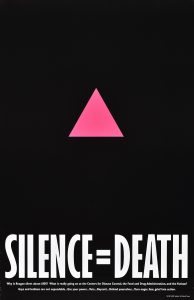
While much of the agitprop commonly associated with ACT UP NY was attributed to the Silence=Death and Gran Fury collectives, there were many other artists and political art collectives working simultaneously, and the lines between them were frequently blurred. For example, Silence=Death was designed to be a consciousness-raising project and was consequently in the public domain; artist Keith Haring expanded on the phrase in a fundraising poster for ACT UP in 1989. Haring, who died of AIDS in 1990, also used the phrase in many silkscreen prints sold through his gallery. Outside of AIDS activist circles, these works by Haring are likely better known than the poster that inspired them.
Ignorance = Fear/Silence = Death (1989), by Keith Haring
Poster House Permanent Collection
Gang was one of the collectives making work within ACT UP NY that also had members who worked with the fierce pussy and Gran Fury groups.
AIDS Crisis (1990), by ACT UP/Gang
Poster House Permanent Collection
Inside, Outside, & Everywhere In Between
ACT UP consisted of many subgroups, affinity groups, committees, and subcommittees; it represented a broad diversity of political experiences and identities, and no strategy was off the table, legal or extralegal, from electoral tactics to armed resistance. In the American election year of 2026, this flyer is particularly noteworthy for its critique of both parties’ responses to AIDS and in the context of the stripping of global funding for HIV and AIDS by the current administration. ACT UP actually attended the Republican National Convention in New Orleans in 1988, establishing multiple ACT UP organizations along the way. Gran Fury based its Read My Lips poster campaign on George H.W. Bush’s earlier stump speech promise “Read my lips… no new taxes.” It’s also worth mentioning that a lone ACT UP member, Frank Smithson, dogged Bill Clinton at every single speech he made during the 1992 presidential campaign, holding up a Silence=Death poster and shouting “What about AIDS?” from the audience.
AIDS Is A Primary Issue (1992), by ACT UP
Poster House Permanent Collection
This repeated public heckling by a single individual contributed to President Clinton’s appointment of Bob Hattoy, the first person living openly with AIDS, to a White House position (Associate Director of Personnel). The impact of Smithson’s lone voice proves that no form of agency is too small to have a meaningful impact on the larger body politic, and that, in a culture rooted in images, no form of visual mediation is insignificant. Political posters and ephemera map the progress of activist ideation for us and point to effective strategies for addressing struggles we have yet to imagine.
Avram Finkelstein is an artist and writer living in Brooklyn, a 2024 Creative Capital and 2023 Pollock-Krasner grant recipient, and a founding member of the Silence=Death and Gran Fury collectives. He is featured in the American Artist oral history project at the Smithsonian’s Archives of American Art. His book, After Silence: A History of AIDS Through its Images, is available through University of California Press and was nominated for an International Center of Photography 2018 Infinity Award in Critical Writing and Research and a 30th Annual Lambda Literary Award in LGBT Nonfiction. He has work in the permanent collections of MoMA, the Whitney, the Metropolitan Museum, the New Museum, the Smithsonian, the Brooklyn Museum, the Victoria and Albert Museum, and the New York Public Library, and his work has shown at the Whitney Museum, The Shed, the Metropolitan Museum, the New Museum, the Brooklyn Museum, the Hirschhorn Museum, the Cooper Hewitt Museum, Grey Art Gallery, the Migros Museum, the Museum of the City of New York, and the Leslie Lohman Museum. He has had numerous public commissions and residencies, including the The Sharpe-Walentas Studio Program, Pioneer Works and The Hemispheric Institute of Performance and Politics.