


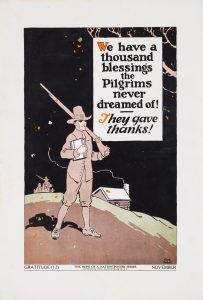
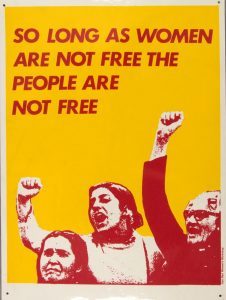
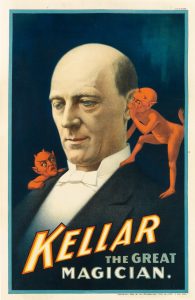
City dwellers for decades (millennia? since time immemorial?) have seen the same three words—“Post No Bills”—painted, sprayed, and displayed on walls and construction barriers. It’s a legal prohibition against pasting posters, broadsides, and advertisements on any surface you don’t own. And let’s be real, this one has certainly been ignored. I love that about it. The poster is the medium you reach for when you don’t control the wall (the narrative, the power), and the wall that forbids them is the most attractive blank canvas, which ends up covered with them. But that’s from a protest angle. Millions of dollars go into guerrilla marketing—must go to this concert, look younger with this cream, speed up time in the kitchen, wear this jacket to fit in—all ideas that are repeatedly posted.
Image Source: Jess Hawsor
As a Native person, I can’t help but notice who’s included (or not) in all these advertisements. That question is why I keep returning to one particular body of posters: the advertising for Buffalo Bill’s Wild West.
For millions of people at the turn of the 20th century, these posters were the draw that brought them to see mythic reenactments of the American West. They taught the country how to picture people like many of our Native ancestors. I want to look at them honestly, which means resisting the urge to make them simpler than they are.
Let’s start with the namesake. William F. Cody earned the name “Buffalo Bill” as a hunter, killing an estimated 4,282 buffalo in 18 months when he was under contract to feed Kansas Pacific Railroad crews in the late 1860s. That killing was commercial, not military. But it happened during a period involving the mass slaughter of bison that was actively encouraged by the leaders of the U.S. Army—Generals Philip Sheridan and William Tecumseh Sherman among them—to force Plains Nations onto reservations by destroying the animal their economies, diets, and lifeways were built around. The bison population fell from roughly 60 million in the mid-19th century to a few thousand by the early 1880s. I can hold the fact that Cody hunted for meat, and the fact that his name became attached to a near-extermination, in the same hand. Both are true, but it’s complicated.
Buffalo Bill’s Wild West (1905), Designer Unknown
Image Source: Potter & Potter
Cody founded Buffalo Bill’s Wild West in 1883. Over about three decades, it played to an estimated 50 million people in the United States and Europe, and was advertised in hundreds of posters, most produced by the Strobridge Lithographing Company of Cincinnati, Ohio. Those chromolithographs were among the most widely circulated images of the West in their era: mass-produced, brightly colored, and pasted up in city after city.
Left: Chief Iron Tail with Buffalo Bill’s Wild West (1908), Designer Unknown
Image Source: Swann Auction Galleries
Right: Buffalo Bill’s Wild West Combined with Pawnee Bill’s Great Far East (1908), Designer Unknown
Image Source: Smithsonian National Museum of American History
Here’s what surprises people when they actually look: the posters don’t picture Native people in just one way. Some present performers as celebrities—the Oglala Lakota performer Iron Tail was so recognizable he was later cited as a model for the Indian Head nickel, issued in 1913. Some are portrait studies, like the one here captioned “Arrow-head, the Belle of the Tribe.” (Insert what scholars identify as the “Indian princess” stereotype here.) Some show Native figures as attackers in staged battle scenes. Others render them as dignified members of a “vanishing race,” a stock idea of the period. Star, threat, and ghost—sometimes within a single campaign. I find that range more unsettling than a flat insult would be because it’s harder to dismiss.
Buffalo Bill’s Wild West and Congress of Rough Riders of the World (1899), Designer Unknown
Image Source: Library of Congress
And the performers were real, paid people. Most were Oglala Lakota from the Pine Ridge Reservation in South Dakota. According to historic accounts, most earned around twenty-five dollars a month; Sitting Bull, who toured briefly in 1885, reportedly made about fifty dollars a week plus income from autographs. Between roughly 1885 and 1898, the show’s performers reenacted historic battles and events—the Battle of the Little Bighorn and the death of Custer, and after 1890, the Wounded Knee Massacre.
That last fact is where I slow down, and where I’ll tell you the history is genuinely debated rather than tell you what to conclude. Some historians read these shows as exploitation: stereotypes sold by the ticket, Native people paid to perform their own recent catastrophes for a crowd over and over and over again. Others—L.G. Moses’s Wild West Shows and the Images of American Indians, 1883–1933 is the standard reference—argue that the “Show Indians” exercised real agency, negotiating contracts, earning wages, and traveling the world at the exact moment federal policy was working to confine and erase them. Firsthand Native accounts survive, including one by the Lakota holy man Black Elk. When I sit with it, I don’t land cleanly on either side. Native people got off the reservation system. They got off it to reenact the worst traumas of their lives on repeat. It cuts both ways.
Left: Santa Fe/Navajo Land (c. 1949,) by Willard Frederic Elms
Image Source: Poster House Permanent Collection
Right: Santa Fe/Hopiland (c. 1949), by Don Perceval
Image Source: Poster House Permanent Collection
It helps to remember that Cody’s posters weren’t an exception in American graphic design; they were an early, vivid chapter in a much longer tradition. A generation later, the Santa Fe Railway produced a beloved series of travel posters selling the Southwest—Land of Pueblos, Navajo Land, Hopiland, Meeting of the Chiefs, Indian Detours—and presenting Pueblo, Hopi, and Diné people as timeless scenery along the rail line. Several were created by non-Native artists; Hopiland’s designer, Don Perceval, was English-born. The same railway even sold guided access to Native life directly with its Fred Harvey “Indian Detours” motor tours to the pueblos. There are no wages in these, no contracts, no performer with a name. The image of Native life has been lifted clean away from any living Native person and turned into a destination.
Santa Fe/Indian-detours (1939), Designer Unknown
Image Source: Poster House Permanent Collection
I go back and forth on which is more complicated to understand or unpack. Cody’s posters are well crafted, loud—and, by many readings, exploitative—and they involved named, paid, world-traveling people who left their own record. The railway posters are gorgeous in a style we all are drawn to, the printed picturesque—the kind of thing you’d frame—and arguably more extractive, because they didn’t need the Natives at all, only our ways of life, a people of the past, a lost mythology. There isn’t a clean answer. The through-line, across both, is the one that stays with me: for most of this history, Native people were the subjects of posters far more often than their authors—pictured constantly, and almost never in control of how, when, or by whom.
That’s the inheritance these posters leave. They are beautiful and they are complicated. They sold a spectacle, employed real people, flattened Nations into costume, and preserved faces and names that might otherwise have been lost—all on the same paper. What I keep asking, standing in front of this stuff, is simpler and harder: whose image ends up posted there, and who finally gets to decide when we post no Buffalo Bills?
Brian Johnson (Monacan Indian Nation) is a designer, curator, and partner at Polymode. He is a cofounder of BIPOC Design History, an online learning platform, and has lectured and led workshops at the Walker Art Center, the School of Visual Arts, the Institute of American Indian Arts, AIGA’s National Design Conference, and the Rhode Island School of Design. His clients include the New York Times Magazine, MIT Press, A24, Nike, the Metropolitan Museum of Art, and the Cooper Hewitt, Smithsonian Design Museum. A 2025 Mellon Fellow at IAIA’s Research Center for Contemporary Native Arts and recipient of the 2023–24 Hyperallergic Emily Hall Tremaine Journalism Fellowship for Curators, his work centers Native-made design to combat erasure and decolonize the field.